One Baptism, Dozens of Cousins: Solving a French-Canadian Brick Wall
Even though French-Canadian Catholic parish registers are surprisingly complete even as far back as the latter part of the 17th century, it can still be a challenge to actually find someone in them.
French Canadian names are notorious for having multiple spellings that sound exactly the same when spoken. In addition, they often suffered from anglicization after the move south across the border. For example: Deschambeault / Deschambeaux / Deschambaut / Deschambautt / Dechambeau / Dechambeault / Dechambeaux / Des Chambault / De Chambeau, anglicized to Shambeau / Shambo / Dishambo / Deshambo.
For us today that isn’t much of a problem. Think about what happens every time you tell someone your name who has to write it down or enter it into a database. Right? The first thing the clerk will say to you is “Could you please spell that for me?” Well, for our ancestors that was often not an option - because they were unable to spell their names. Everyone who has done any amount of pre-1900 genealogy is well familiar with the X and annotation “his” or “her mark”, or the French equivalent “ont déclaré ne savoir signer” (declared that they didn’t know how to sign), or some variation thereof. By the time of the 1871 census, only about 50-60% of French Canadians were literate, and the percentage was even lower in rural areas. On top of all that, the priest or clerk’s handwriting was often atrocious, leading to transcription errors.
Consequently, to capture all the possible variations while doing a database search for a person requires time, patience - and the creative use of wildcards.
Then there is the French-Canadian tradition of “dit” (aka - also known as) names, secondary family names.
It all started with the military: Soldiers who enlisted in the French military customarily adopted a nom de guerre (war name) to protect their identity and maintain military records. When these soldiers retired from the military, received land grants and married local women, they kept their military moniker. A soldier named Jean Baptiste Lalonde whose war name was Latreille became Lalonde dit Latreille in the parish registers, and his children inherited both names.
In addition, early New France had a massive demographic bottleneck: a very small group of original founding families had an incredibly large number of children. Within three generations, an entire village might consist of dozens of families, all named Tremblay, Gagnon, or Roy. To make matters worse, they heavily reused the exact same first names (almost every boy was baptized Jean-Baptiste or Joseph, and every girl Marie). So, families tacked a dit name onto their original surname to distinguish their specific branch from their cousins down the road.
A family might use both names interchangeably for 150 years. So, someone might be baptized Fleury dit Deschambault, recorded as just Deschambault for their marriage, and just Fleury on their burial record. Around the mid-19th century, as record-keeping gradually standardized, families finally picked one name and dropped the other - meaning two brothers could end up legally establishing two entirely different modern surnames.
In this case, the client had provided the following info: she was looking for proof of Canadian birth for Arthur Joseph (Josephat?) Chabot, born approximately 1893 in Canada, married to Exilda Paquin. There was some documentation for his life in the US, but she had run into a brick wall trying to trace him across the border.
Thankfully, it was fairly easy to find Arthur Joseph and Exilda’s marriage registration in Fitchburg, Worcester, Massachusetts on 4 Aug 1913. And, very fortunately, marriage records in that place and time recorded the names of the parents of both bride and groom. That gave me something to work with. Arthur’s father was one Cyrille Chabot, his mother Rose Delima Dupuis. While Chabot and Dupuis are quite common French family names, the first names Cyrille and Rose Delima are a bit less common, and certainly in combination. Had it been Jean Baptiste and Marie, I might not have been able to progress further.
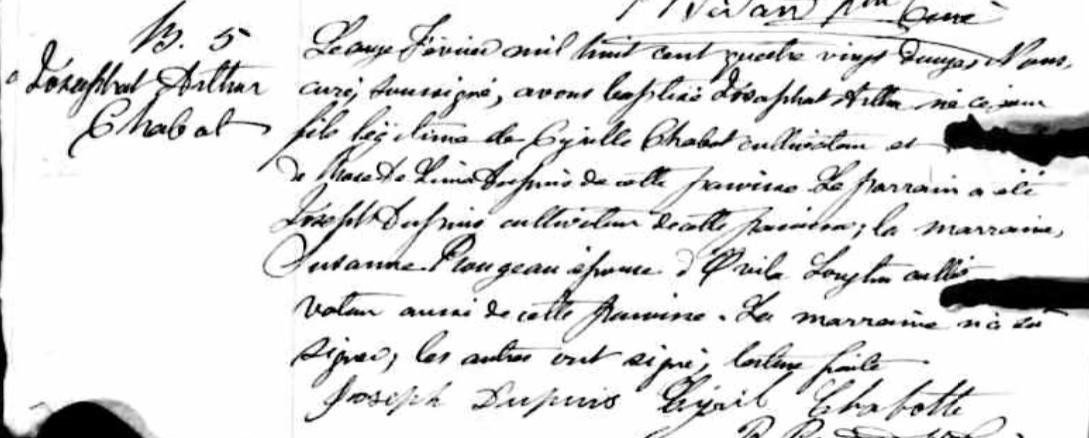
But this information allowed me to search the databases and narrow down which of the multiple Joseph or Arthur Chabot entries - and there were dozens of them within approximately the same time frame - was in fact M’s Canadian ancestor. Success! Josaphat Arthur Chabot, son of Cyrille Chabot, farmer, and his wife Rose De Lima (note the spelling variant Delima/De Lima) Dupuis, was baptized on 11 Feb 1892 in St-Constant, Quebec – not that far from Montreal as the crow flies, but on the other side of the St Lawrence River. Josaphat Arthur had become Arthur Joseph – another example of the many ways names could morph from one document to the next.
The client had mentioned that she was one of a large group of extended family all working together to establish Canadian citizenship by descent. This one previously missing document will now allow all of them to move forward.
Many of our ancestors have many descendants. If one person does the work to document the family line, many people could benefit.
