The Canadian Ancestry of Norman Young, WWII Hero
This week’s case study: A. suspected that her maternal great-great grandfather might be of Canadian descent. She knew that her great-grandfather, Norman Young, had fought in WWII and received a purple heart.
The challenge: Darn spelling variations and clerical errors…
The information about Norman’s service in WWII was a great starting point, and I quickly found his draft registration card. It told me that Norman James Young was in fact himself born in Canada, in Loggieville, New Brunswick to be precise, on 19 Sep 1917. He gave as his contact his mother, Leona M. Young who lived on Corson Ave. in Tompkinsville (on Staten Island), New York.
Working backwards through census records we find him in the 1925 state census, living at that same address in Tompkinsville with his parents Herbert and “Lenoa” (Leona misspelled) and three siblings, Cottrell, Corinne and Reta (more likely Rita). Norman, his mother and his oldest two siblings were all recorded as born in Canada. His father and the youngest were however born in the U.S. Herbert Young’s trade or profession is listed as “Captain”.
It seems that they had only fairly recently arrived in the US, because we also find them all (except for Rita who wasn’t born yet) in the 1921 Canada census, in the Chatham parish of Loggieville, NB. They are living in the household of Adolph and Mathilda Burke who also have a daughter called Rita. The census taker noted that Herbert was born in the US, but his father was from New Brunswick and his nationality was Canadian. He was a cook.
Norman’s social security registration confirms that he was born in New Brunswick 19 Sep 1917 and that his mother’s maiden name was Burke. The Burke family they were staying with in 1921 were in fact Leona’s parents and sibling.
With this I searched for Norman’s birth registration in New Brunswick. And I found a record for Norman James Young, with a father Herbert. BUT it also said that he was born on Oct 15 in Moncton, and that his mother’s name was Norma James. A doctor called McNaughton attended the birth, but the birth certificate was signed neither by either parent, nor the doctor, but by E. Savage. Who was that, and how well did they know the family???
Hoping for additional clues I checked for birth registrations for Norman’s siblings, Cottrell and Corinne. There was one for Cottrell, but it was a late registration, done when he was an adult. There wasn’t one for Corinne at all. It didn’t seem like the Youngs were in the habit of registering their children’s births. So why was there a birth registration for Norman, and why were some of the details incorrect?
Another record gives us some further clues. On Sep 16, 1918, Herbert, Norman’s father, filled in a draft registration card. Since he was a US citizen (the census taker in 1921 may have made a mistake), he did that at the US Consulate in Moncton. Among other things the card states that he was a munitions inspector at a foundry in Moncton and that he had a wife and an 11-month-old child. So, the family had moved to Moncton during the war, likely for the purpose of Herbert’s work at the munitions factory. Moncton had a large hospital with a proper maternity ward and Norman was probably born there. After the war, the family returned to Loggieville. Norman would have been too young to remember that and when asked about his place of birth later in life just remembered that his family “was from Loggieville”. In addition, if Herbert stated in Sep 1918 that he had an 11-month-old child, then it is more likely that the October birth date on the birth certificate is the correct one. And the mother’s name? It is a little suspicious that Norma James is so very similar to Norman James. I can see an administrator transferring information from a running ledger onto the birth certificate simply making an error and copying the mother’s name from the wrong line. Also, “Leona Jane” when spoken quickly in perhaps a noisy hospital environment could sound very similar to Norma James. I feel pretty confident that this is indeed Norman’s birth certificate.
With Norman’s Canadian birth established, I could have stopped here. However, my searches had brought up a number of other documents that were simply far too interesting to ignore.
US WWII service records were mostly lost in a fire in 1973, but a National Guard register from the 1950s gave a lot of detail about Norman’s military service. It took a bit of effort to work through all the abbreviations, but the results were well worth it. Norman must have been an exceptionally courageous man.
YOUNG, Norman J - Captain, NJ (New Jersey), service number 01317217, born Canada, 19 September 1917.
Service chronology:
28 Sep 42 - ERC – Enlisted Reserve Corps
12 Oct 42 - began active duty
14 Apr 43 - commissioned/promoted to 2nd Lieutenant, Infantry
2 Feb 46 - promoted to Captain
1 Apr 46 - into Inactive Reserve (ORC = Officers Reserve Corps)
1 Jul 50 to 22 Sep 53 — recalled to active duty (this recall period likely reflects the Korean War mobilization)
6 May 53 — Captain, Infantry confirmed
27 May 54 — transferred to Armor branch
11 Jan 55 — Inactive National Guard (NGUS = National Guard of the United States)
Decorations:
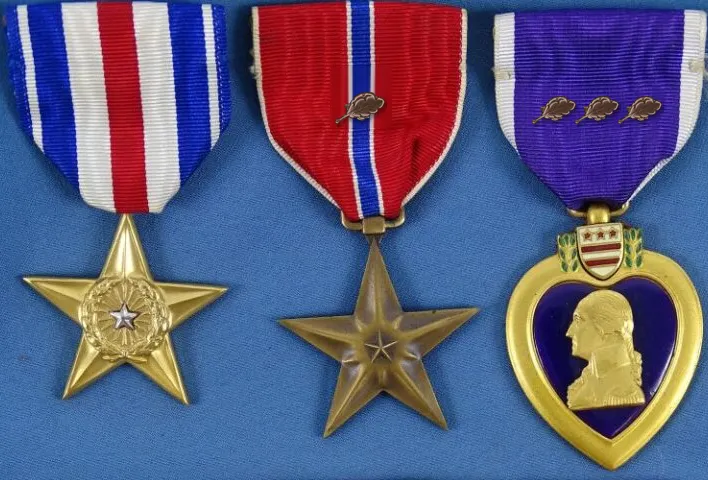
Silver Star Medal (SSM) Awarded for combat valor.
Bronze Star Medal (BSM) with Oak Leaf Cluster. Can be awarded either for heroism in combat or for meritorious service. With OLC means two awards.
Purple Heart (PH) with 3 Oak Leaf Clusters. Awarded for wounds received in action against an enemy. Three OLC means four total awards — he was wounded on four separate occasions. That is a significant number and suggests sustained front-line exposure.
I found a transcript of an article in a Dec 15, 1944 edition of Stars and Stripes (the official US military-authorized newspaper serving deployed American troops) online, with a paragraph that read “Bill Mauldin's outfit claimed winning at least a three-cornered race in the Third Battalion of the 45th Division's 180th Infantry.Company "K" led by 1st. Lt. Norman J. Young, Staten Island, N.Y.,reported entering Germany west of Wissembourg at 1345 hours.”
I don’t know how reliable this is (and didn’t have the time to do more in depth research), but if it is correct then we now know which regiment he served in and could track his path through his entire time in WWII. His company participated in the invasion of Sicily, the amphibious attacks on Salerno and the Anzio beachhead and pushed into the mountains of Italy. They invaded southern France, breached into Germany in the winter of 1944 and were present at the liberation of the Dachau concentration camp.
This is truly an ancestor to be proud of!
I also found out some more interesting things about his father, Herbert Young. Leona was not Herbert’s first wife. He had married before, in his home town of Rockland, Maine in 1897. His bride, Bertha E. Snow, was from Nova Scotia. At that time, Herbert was a seaman.
A surviving 1909/1910 crew list for a US schooner bound for Nova Scotia lists Herbert as one of 5 crew members, the other crew consisting of one Russian, a Norwegian, a Dutch and a Dane! Truly an international outfit!
I don’t know what happened to Herbert’s first wife Bertha, but we saw that when he was living with his in-laws in Loggieville in 1921 he was a cook. In Nov 1924, by then in the US, he applied for a “Seaman’s Protection Certificate” and stated that he was serving as a cook on the barge Mattagorda, which was owned by his brother-in-law. There even is a photograph of him in the certificate! And as we have seen in the 1925 census record he had by then become “captain”, possibly of the same barge.
Unbelievably, Herbert also filled in a WWII draft registration card, at the ripe age of 62! His 1952 obituary mentions that he had broken a hip in 1944 in an accident involving a crane while unloading a barge. His wife Leona had died a few months earlier in a car accident.
The Youngs were an interesting family, moving and marrying back and forth across the US/Canada border, not unusual for the time and place.
A final note: I do my best to try to find links to original documents on free sites, so that everyone can look at them without having to have a subscription to several databases. Unfortunately, it is not always possible and some things are only available behind a paywall, as was the case for this project.
